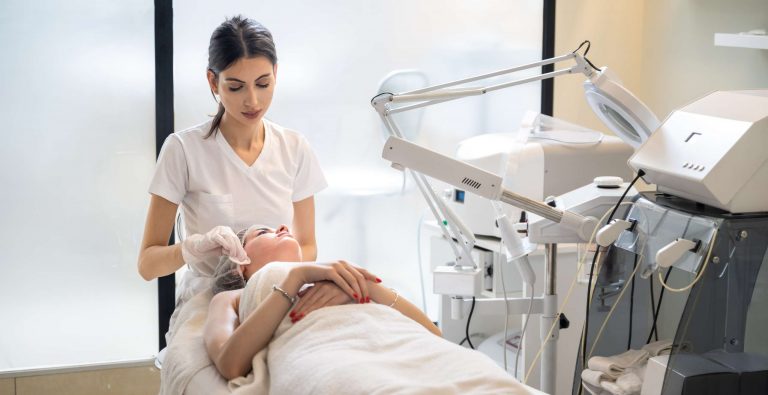

How to Practice Basic Facial Technique Without Guessing
Your first facial practice session is less straightforward than you might assume. At times, the steps seem obvious, and at other times, the process of cleaning, priming, applying, removing, and repeating gets muddled. Your biggest problem at this point is not doing too much. Your biggest problem is learning how to observe what each step is meant to do. A helpful strategy for sorting out the beginning is to shift your thinking away from the facial as one technique. Start thinking of it as a series of small choices that visibly change the skin, and if the change is clear, the technique gets easier to replicate.
Start with a visual assessment before proceeding to touch. Look carefully at the skin in a natural light, and describe what you see with plain words. Is the skin dull, shiny, lopsided, tense, or easily inflamed? This moment of pause is a habit you will need later because your products and pressure should be guided by what you see, not by what looks good in a photo or video. Then, practice just the first part of a facial for a few days: clean, rinse, dry, and prime. Your motions should be smooth and steady. Pay attention to how much product you use, how much time you take, and if the skin appears cleaner and more refreshed rather than agitated or over-manipulated.
The most common error during this phase is to race into the massage or treatment steps before the skin is properly primed. You may believe the technique “meat” of the facial is where the magic happens, but insufficient priming undermines all subsequent efforts. If you leave behind cleanser, rub when you mean to soothe, or apply product over still-damp spots unevenly, the effect will be clumsy and difficult to evaluate. The fix is straightforward but demands some discipline: slow down your first five minutes. Apply less pressure than you think you need, maintain consistent contact, and check the skin between steps rather than barreling on by rote.
If your practice sessions are hit-or-miss, shorten them. A short, focused practice session teaches you more than a long one conducted largely by guesswork. Spend the first three minutes looking at the skin and setting up your tools so that nothing breaks your concentration. Spend the next five minutes cleaning with deliberate attention to stroke direction, pressure, and product removal. Spend the next four minutes applying product to discrete areas and observing how well it disperses and how well your hands behave. Finally, spend three minutes evaluating what went well, what felt clumsy, and what you would do differently next time. This evaluation is important because it allows you to use one practice session as the beginning of your improvement rather than as a one-off attempt.
If you struggle, pick one thing to improve rather than trying to improve everything at once. Perhaps you struggle to apply cleanser smoothly, or perhaps your hand motion falters when you switch from one side of the face to the other. Concentrate on one issue at a time for several sessions. Repeat the same troubled section slowly, almost as if it were a drill, until the gesture starts to feel familiar. It may also help to work in front of a mirror and compare the two sides of the face after each pass. The object here is not to build speed; the object is to build sufficient control that it endures even when you are a bit fatigued, preoccupied, or uncertain.
Your technique becomes more consistent when your eyes learn alongside your hands. At the end of every practice session, look for signs. Was the skin calmer? Was it redder? Did the product adhere smoothly? Did it pool around the eyes? Did your stroke stay steady from beginning to end? These little questions give you useful feedback even if you are practicing alone without feedback from anyone else. With practice, the facial gradually ceases to feel like a technique you are trying to memorize and gradually starts to feel like a technique you can read, adapt, and perfect by design.